
What is Italian Majolica Pottery? | Our answer for you
Published by MOD Deruta Editorial Team on Mar 28th 2021
The craft explained
A brief introduction to the technique
behind Deruta's tradition
Clay · Two firings · Hand-painted glaze
The method passed down for five centuries
"A terracotta object, enameled and fired twice —
that is majolica, in one sentence."
In this article, we will briefly summarize the technique of making majolica — the method that has defined Deruta's ceramic tradition since the Middle Ages and still guides every piece produced in our workshop today.
Chapter One
It Begins with Clay
To create a majolica artifact, it is first necessary to produce a support — a biscuit, or terracotta form. The process begins with clay, a raw and malleable earth that is shaped by hand, modeled according to the intended design, and left to dry.
The dried piece is then fired in a special kiln at a temperature of approximately 1,000 °C. This is the first firing — the one that transforms raw clay into a porous, solid ceramic body ready to receive the glaze.
Chapter Two
Applying the Glaze
Once the piece has left the kiln, it must cool back to room temperature before moving to the next phase. A special ceramic glaze is then applied to the terracotta object — whose surface is now porous and ready to absorb it. First, the piece is checked to ensure no dust or marks remain on the surface.
Application techniques vary — from immersion (dipping the piece directly into the glaze) to spraying. The glaze itself can also be of different types, depending on the final effect the artisan wants to achieve.
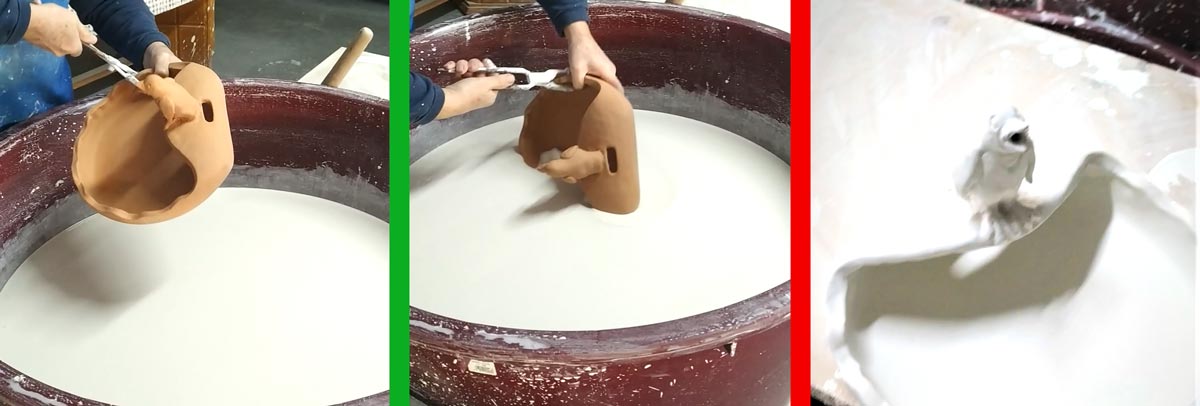
The glazing stage — our workshop in Deruta, Umbria.
Between the first and second firing, the piece is at its most expressive — a blank white canvas waiting for the painter's hand.
Chapter Three
The Second Firing
Once the entire surface of the object has been covered with the chosen glaze, it must be left to dry. Then comes the second firing, this time at a temperature ranging from 900 °C to 980 °C. When the object emerges from this second firing, we have our majolica piece — transformed, permanent, radiant.
Chapter Four
What Makes Deruta Majolica Different
In the case of our Deruta ceramics, a crucial step happens before the second firing. Once the piece has been glazed in white and left to dry, it is painted entirely by hand by our master painters — every pattern, every brushstroke, every fine detail applied while the glaze is still raw.
These pieces still belong to the category of majolica, but they carry a distinct name: "Painted Majolica Objects". It is this painting stage — demanding, irreversible, and deeply personal to each artisan — that gives Deruta majolica its unique soul.
In one sentence
Majolica is a terracotta object, enameled and fired in a kiln
at a temperature between 900 °C and 980 °C.
See the craft in action
Explore Our Hand-Painted
Majolica Collection
Every piece on our shop follows exactly the process described above — shaped, glazed, hand-painted, and fired twice in our Deruta workshop.
Browse the CollectionAbout the authors
MOD Deruta Editorial Team
The editorial team at MOD Ceramics documents the living tradition of Deruta majolica from a family workshop founded in 1965. Every article is reviewed by the master decorators and artisans who practice these techniques daily in our laboratory in Umbria, Italy.
Deruta, Umbria — Italy · info@derutaitaly.com